
Check whether a review can be challenged · Letting agency owners and property managers
A tenant’s Google review blames our letting agency for landlord-managed repairs. What should we check?
Separate the complaint about the unfinished repair from the tenant’s experience of your agency. The landlord may control the work while your team receives the report, sends an update or arranges access. Check those steps before deciding whether the review points to a different business or describes your own service.
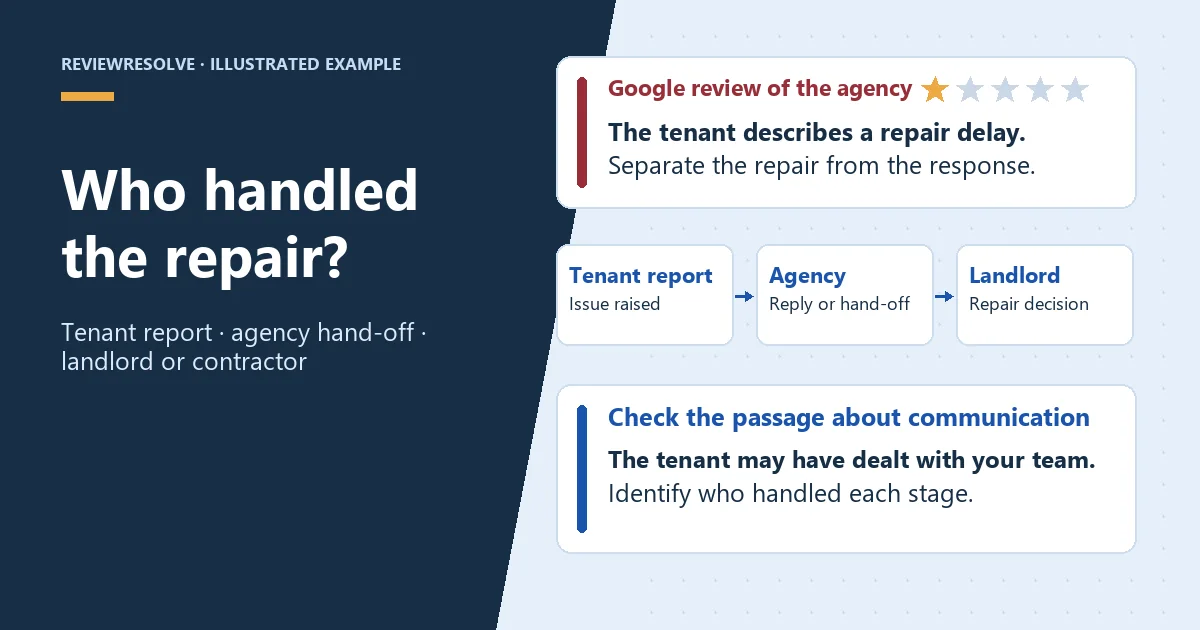
Identify which service the review describes
Use your management scope and repair log to identify what the agency actually handled at the time. For a let-only instruction, the agency may have passed a message to the landlord or told the tenant where to report it. In a managed tenancy, agency staff may have logged the job and coordinated visits. What happened in practice can matter more to a review than the general service description on the agency’s website.
The example below follows a private tenancy in England. GOV.UK sets out the landlord’s usual repair responsibilities. That guidance and Google’s review policy answer different questions. Google asks whether the review concerns a genuine experience. A tenant who interacted with agency staff may have a genuine basis for commenting on the reply they received.
Rebuild the repair as a sequence of actions
| Question | Internal record to check | What the record can establish |
|---|---|---|
| Who received the tenant’s first message? | Inbox, portal or call log and its receipt time | Where the report entered your process. |
| What did the agency tell the tenant? | An acknowledgement or response in the relevant channel | Whether you confirmed receipt, provided a route or promised an update. |
| Who could arrange the work? | Applicable management instructions and any hand-off | Who received the instruction or authorisation request. |
| What action followed? | Contractor booking or completion information available to the agency | Which visits or checks you can confirm. Keep any gap visible. |
If a review instead names an unrelated managing agent or describes a property your firm never handled, check whether a portfolio transfer or former trading name could explain it. A public office or business page can help distinguish two agents. A missing match in the current tenancy system is weaker evidence after a portfolio has changed hands.
Keep the review and repair routes clear
For a genuine complaint, deal with the repair through the relevant channel and offer a private follow-up. A short public response could say ‘We’d like to look into the communication you describe. Please contact our office or use our usual repairs channel.’ Keep tenancy dates, addresses, photographs and contractor notes in the appropriate records.
If the evidence points to a separate Google policy issue, describe the specific mismatch and save the public review link. Keep the tenant’s existing complaint route open. The agency can consult the government’s redress guidance for complaints about an agent’s service in England.
Sources
- GOV.UK private renting repairs guidance
Explains the usual responsibilities for repairs.
- GOV.UK redress schemes for lettings agents and property managers in England
Explains how redress applies to complaints about an agent’s work in England.
- Google Maps policy on reviews and genuine experiences
- Google Business Profile review reporting instructions