
Decide whether to hire help · Regional and multi-site managers
Which Google Reviews Are Worth Paying to Challenge When Several Branches Are Affected?
When several branches receive disputed Google reviews, start with the specific review and its reporting status. Put paid preparation towards cases with an identifiable policy concern, useful evidence and an available next step. Set your spending cap against the bill if every approved review is removed, since each successful removal can add a separate fee.
Give every review a branch and a case owner
Record the branch address, listing and review link, what the review alleges, the public evidence you can point to and any report or appeal already made. At head office, give each review one case owner. Ask branch staff to confirm facts about their own services. Have the authorised profile manager check Google's status so the central team and branch do not work the same case independently.
A review can describe a real experience even when one part of the story needs checking. If a customer used an agency, delivery partner or another branch, document each business’s role. A shared logo or a similar branch name can explain a mix-up. The precise conflict between the review and the location is what makes it worth assessing.
Apply the same decision rules across branches
- Reply or resolve genuine service complaints where you identify no separate policy issue.
- Monitor a pending report. Confirm whether new evidence would change the next decision before commissioning more work.
- Gather evidence if the policy concern is plausible but the link, location or facts are uncertain.
- Consider first-report preparation or eligible appeal review when a specific policy concern, supporting facts and an available route line up.
| Case and branch | What the regional manager can verify | Google stage | Next decision |
|---|---|---|---|
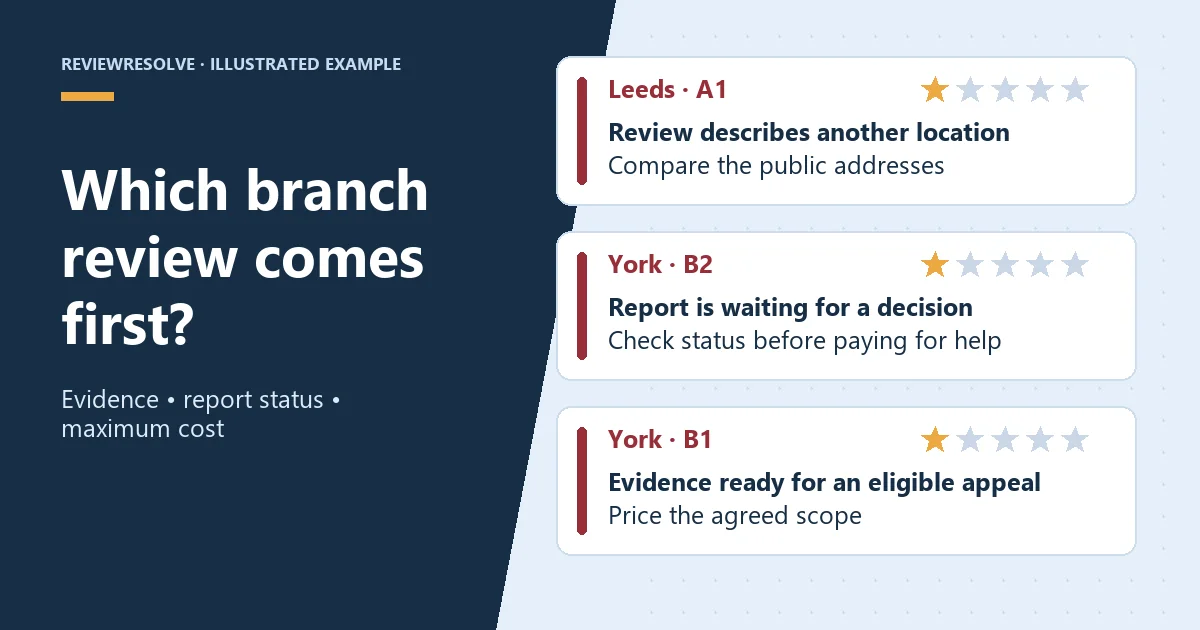
| A1 · Leeds | Review says a named flooring showroom refused a return. It gives the address of that showroom, while the Leeds profile belongs to a collection desk at a different address. | No report | Shortlist for first report |
| A2 · Leeds | One-star rating without text and no further evidence. | No report | Gather evidence only if a specific concern emerges |
| A3 · Leeds | A customer describes a long collection queue. The branch confirms a delay that day. | No report | Resolve the service complaint |
| B1 · York | A passage reproduces a staff member’s private mobile number. An authorised manager confirms it is a personal number. | Appeal option shown | Shortlist for eligible appeal review |
| B2 · York | Two posts use similar wording. The branch reported one and has no additional facts yet. | Decision pending | Monitor and record any new evidence |
| B3 · York | The customer describes the firm’s actual refund process and disagrees with it. | No report | Resolve the service complaint |
| C1 · Harrogate | The reviewer describes being dismissed from a role at the branch. The manager can point to a public staff profile from the relevant period that corroborates the connection. | No report | Shortlist for first report |
| C2 · Harrogate | Several critical reviews arrive together. Two describe visits and there is no corroborating link between reviewers. | No report | Separate genuine feedback and check each claim |
Use the highest payable outcome for budget approval
Three of the eight fictional cases have evidence and an available next step. This result follows from the rules and invented inputs. In this example York B1 goes first because the private number is still public. Leeds A1 follows because the incorrect address can be checked directly. If the appropriate route for a sensitive disclosure is unclear, check the policy and the tool before sharing the underlying detail.
Keep one record after you approve the work
Store the final shortlist with the written scope, the case owner’s initials and a budget approval. As Google decides each case, record the status and any evidence that may affect the next step. If another review becomes ready, recalculate the maximum against the same budget before adding it. A changed review or newly available appeal deserves its own recorded decision.
Original worked study · branch budget exposure
The eight case descriptions are fictional. First identify genuine complaints, then set aside pending reports and unsupported cases. Shortlist cases with a concern, supporting facts and an available report or appeal. For every approved count a from zero to the three shortlisted cases, let successful removals r range from zero to a. Preparation = 29 × a. Success fees = 99 × r. Add them for the total. The chart shows the maximum in each group (r = a). The table enumerates all ten count combinations. Each total describes the fees for its assumed outcome, before applicable tax.
- 1 approved · all removed128
- 2 approved · all removed256
- 3 approved · all removed384
| Approved reviews | Successful removals | Preparation (GBP) | Success fees (GBP) | Service fees (GBP) |
|---|---|---|---|---|
| 0 | 0 | 0 | 0 | 0 |
| 1 | 0 | 29 | 0 | 29 |
| 1 | 1 | 29 | 99 | 128 |
| 2 | 0 | 58 | 0 | 58 |
| 2 | 1 | 58 | 99 | 157 |
| 2 | 2 | 58 | 198 | 256 |
| 3 | 0 | 87 | 0 | 87 |
| 3 | 1 | 87 | 99 | 186 |
| 3 | 2 | 87 | 198 | 285 |
| 3 | 3 | 87 | 297 | 384 |