
Check whether a review can be challenged · UK business owners managing a rating with no text
Can a Business Challenge a One-Star Google Rating With No Written Review?
A one-star rating with no text can be reported when other evidence points to a Google policy violation. A blank comment gives you less detail to check against the policy. It does not establish that the rating is fake. Before paying for help, work out what you can show about the specific rating and the listing it sits on.
Start with the facts you can record
Save the public link to the affected listing, the date you saw the rating and an individual review link or screenshot if you can get one. For a business with several locations, confirm the precise branch before looking for records. A mismatch with one branch’s appointment list says little if another branch handled the enquiry or the person dealt with staff by phone.
Google’s policy covers fake engagement and conflicts of interest. A manager who can point to a public, relevant conflict has more to assess than a manager who has never seen the account name before. A short burst of low ratings can justify preserving links and times. It cannot tell you by itself whether any particular rating was fabricated.
For historical context, Google reported blocking or removing 55 million policy-violating Maps reviews worldwide in 2020. Its February 2021 report combines blocks before publication and removals. It gives no separate figures for textless one-star ratings, so that total cannot estimate what happens to a business’s report about one.
Model the change in the average before you decide
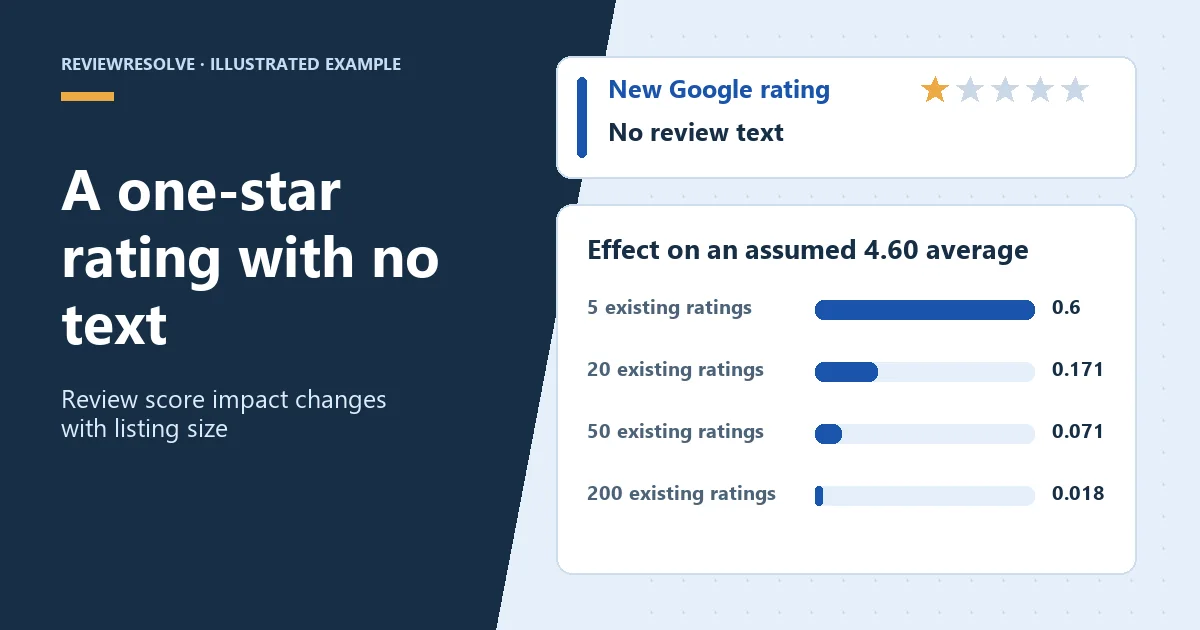
Google calculates the review score as an average of the published Google ratings for the place. The chart shows how adding a single one-star rating affects a fictional listing with a starting average of 4.60. The smallest listing moves by six-tenths of a point. The largest moves by less than two-hundredths.
For example, a location with 20 ratings starts with 92 total stars. One more one-star rating makes that 93 stars divided by 21, or 4.429 to three decimal places. The resulting drop is about 0.171 points. These are exact means rounded for the table. The figure a customer sees depends on the display precision and when the visible score refreshes.
The arithmetic can help a branch manager understand why a few reviews feel disproportionately important. A larger impact on the average supplies no evidence about the reviewer’s experience or whether the review is eligible for removal.
Decide whether to report, monitor or request help
Suppose a fictional independent bike repair shop has five ratings and receives a one-star rating with no text. It cannot connect the public profile name to a service record and sees no other unusual activity. The shop records the rating and checks whether a customer may have dealt with another member of staff. It has no concrete policy theory to put in a removal report.
If another business has a direct demand tied to the rating, Google has a dedicated merchant extortion route. If it can document a different potential breach, the owner can use Google’s free reporting tool. A free ReviewResolve assessment is most useful when you can identify a UK listing, the rating in question and the particular fact or pattern you would like us to assess.
One new one-star rating has a bigger effect on a smaller listing
The original scenarios use four synthetic counts with an exact starting average of 4.60. Each count has a possible whole-number star total. To reproduce a row, add one to the starting star total, divide by the starting count plus one, and subtract the new mean from 4.60. Chart values and means are rounded to three decimal places. The change measures the effect of one new rating under the same assumptions for each listing.
- 5 existing ratings0.6
- 20 existing ratings0.171
- 50 existing ratings0.071
- 200 existing ratings0.018
| Starting count | Starting star total | Starting mean | New star total | New count | New mean | Drop in star points |
|---|---|---|---|---|---|---|
| 5 | 23 | 4.60 | 24 | 6 | 4.000 | 0.600 |
| 20 | 92 | 4.60 | 93 | 21 | 4.429 | 0.171 |
| 50 | 230 | 4.60 | 231 | 51 | 4.529 | 0.071 |
| 200 | 920 | 4.60 | 921 | 201 | 4.582 | 0.018 |
Sources
- Google’s explanation of review scores
- Google Maps policy on genuine experiences and conflicts
- Google’s review-reporting instructions
- Google Maps moderation report covering 2020
Published 18 February 2021. Worldwide Maps moderation activity.
- Google’s merchant extortion guidance