
Report, track or appeal a review · UK operations teams with several declined review reports
Google Declined Three Review Reports. Should We Use the Same Evidence for Every Appeal?
You can reuse the format of a Google review appeal. Reuse a source only when it actually supports the claim about that specific review. Before using an available appeal, give each review a public reference, the policy concern and a sentence showing how the evidence relates to the disputed content.
In this update Added the current review appeal steps and explained which tool UK businesses should use.
Check which reviews can still be appealed
In Google’s Reviews Management Tool, choose the branch and open the screen for existing reports and appeal options. Choose eligible reviews, then open the appeal form and submit the evidence for each item. Google's separate Business Profile appeals tool handles issues such as profile suspensions and rejected business edits in the UK.
Open the Reviews Management Tool with the account associated with the Business Profile. Match the status to each individual review. For a declined report, confirm whether the tool currently shows an appeal option. Google describes a one-time appeal and allows selection of up to ten eligible reviews in the tool. In a mixed group, a pending review needs a status check and a completed appeal needs its decision recorded.
Write a short evidence note for each review
- Start with the public review link, branch address and current status. State the disputed wording or its location within the review. Leave sensitive details out of the overview.
- Identify the possible policy breach, then pair each source with the fact it supports. A public address supports a location mismatch. It rarely supports a claim about a reviewer’s employment.
- Record what remains uncertain. If the same document truly supports two different reviews, reference it for each and explain the link. A common template makes the pack easier to read.
| Review | Possible issue | Two example evidence slots |
|---|---|---|
| A · Wrong location | The review describes a named office at another address. | Public page showing the reviewed branch’s address (A1) and the other office’s public address page (A2). |
| B · Private contact detail | The review includes what appears to be a worker’s private number. | Locator for the relevant passage (B1) and a public contact page showing the published business number (B2). |
| C · Possible conflict | The author describes an employment dispute and says they worked at the branch. | Relevant passage locator (C1) and a dated public team announcement that may corroborate the relationship (C2). |
In case B, the contact page only establishes the published business number. It cannot establish who owns a different number. Ask the affected person to confirm privately whether the number is theirs and whether it is public. In case C, test the identity match before treating the announcement as corroboration. Use a direct Google route for the specific review if you decide to proceed.
Decide what is ready before you commission help
If the facts still amount to a disagreement with an honest account, there may be no policy issue worth appealing. An assessment can help when you have an identifiable review, a relevant Google status and a specific question about how the evidence supports the concern. Google decides what stays online.
Worked study of source matching across three appeals
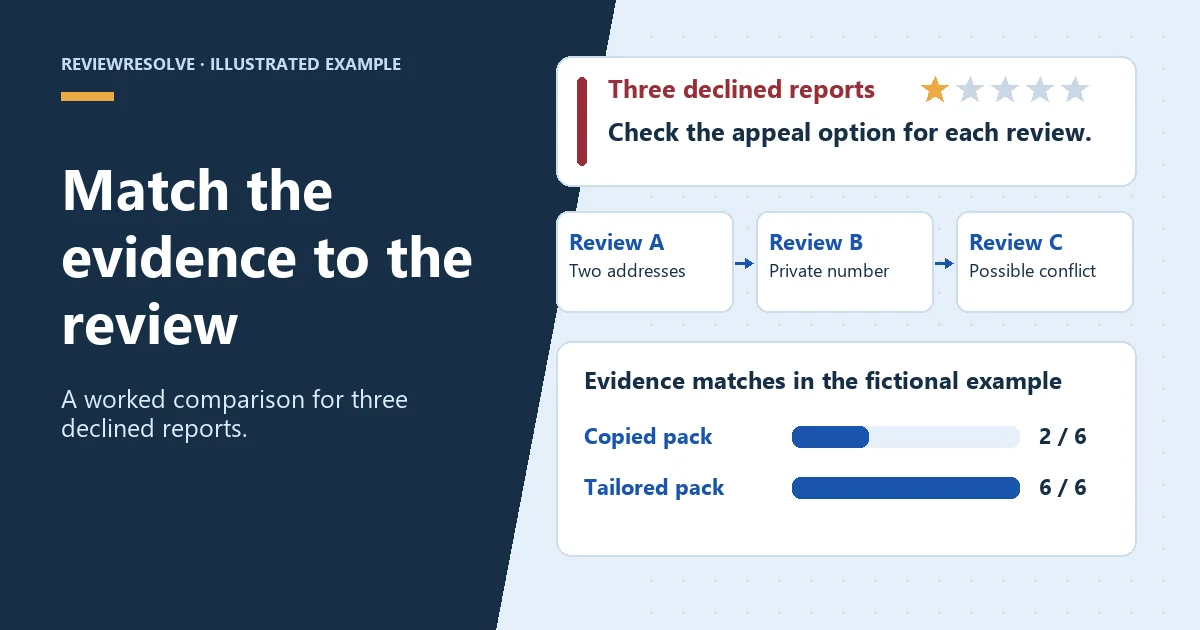
The three reviews and six fact checks are fictional. Each review has two distinct slots to fill. Copying the location pack assigns A1 and A2 to all three reviews. The tailored pack assigns A1 and A2 to review A, B1 and B2 to B, and C1 and C2 to C. For each review count one point for each assigned source ID that matches one of that review’s two slots. Summing the three rows gives two of six matches for the copied pack and six of six for the tailored pack. This model measures whether a citation addresses the intended fact. It gives no removal or appeal prediction.
- Copied pack2
- Tailored pack6
| Review | Target evidence IDs | Copied evidence IDs | Copied matches | Tailored evidence IDs | Tailored matches |
|---|---|---|---|---|---|
| A | A1 A2 | A1 A2 | 2 | A1 A2 | 2 |
| B | B1 B2 | A1 A2 | 0 | B1 B2 | 2 |
| C | C1 C2 | A1 A2 | 0 | C1 C2 | 2 |
Sources
- Google Business Profile Help — choose the appeals tool by decision type
Google’s UK guidance identifies the Reviews Management Tool as the route for customer review removal decisions.
- Google Business Profile Help — reporting status and one-time appeal
Describes the statuses, eligible appeal workflow and up to ten review selections.
- Google Maps User Contributed Content Policy — prohibited and restricted content
Explains the policy categories used to assess each disputed item.