
Check whether a review can be challenged · Diagnostic clinic managers
Can a Private Scan Clinic Challenge a Google Review Written by a Patient’s Companion?
A person can have genuine experience with a scan clinic without receiving or paying for the scan. Before reporting their Google review, separate what they directly experienced from what they heard about someone else’s care. Any claim that relates to an identifiable person deserves private handling.
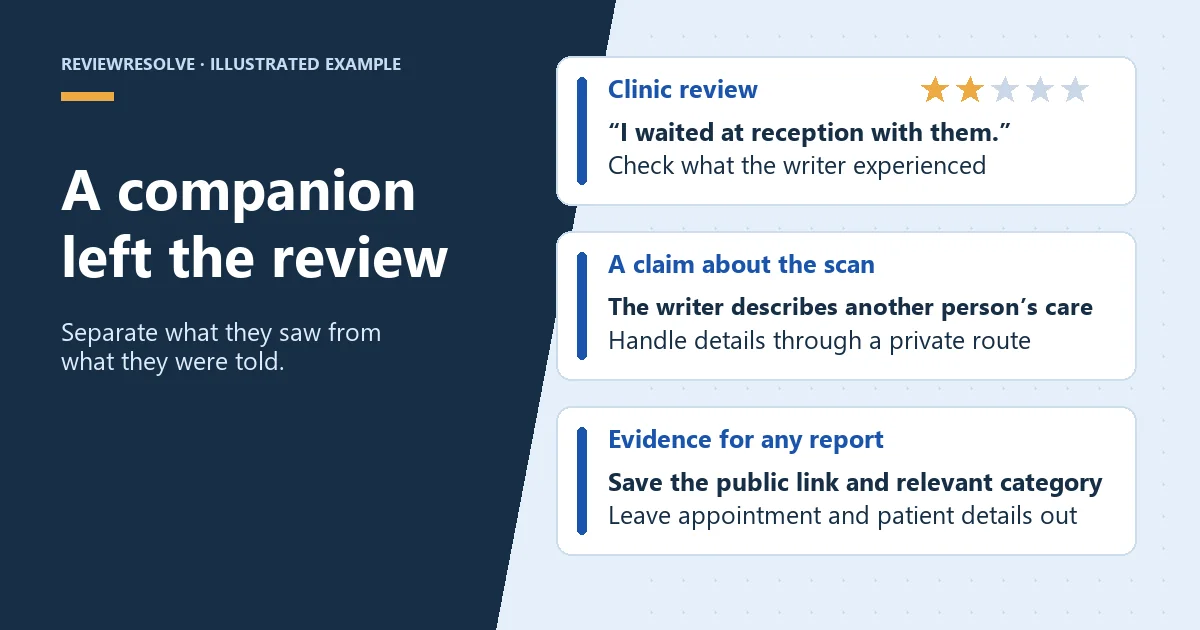
Identify the part of the visit the companion describes
Google’s policy looks for a genuine experience with a business. The useful question for a companion review is whether the writer describes their own contact with your clinic. They might have found the entrance, spoken to reception or waited for news. The clinic can consider feedback about those events without establishing that the reviewer, or anyone they mention, received care.
The reverse also matters. A review that retells something heard online, describes another provider or offers no connection to the clinic may justify a closer policy check. A relationship label such as ‘partner’ or ‘friend’ does not by itself show what the reviewer saw. A patient ledger tells you little about who was in reception.
If the centre sits inside a larger hospital or rents space near another scanner, check who runs reception, takes bookings and delivers the scan. Then compare the actual issue with those responsibilities. A comment about a shared entrance can describe an experience the clinic should still consider, even when the writer confuses the names of two providers.
Separate direct observation from someone else’s account
| Wording to look for | What it may show | Useful next step |
|---|---|---|
| “I waited in the reception area.” | Firsthand contact with the clinic. | Consider the feedback without identifying who received care. |
| “I heard that another person’s scan went badly.” | An attributed secondhand claim. | Handle care questions privately and look for context before reporting. |
| “The clinic was in a named building across town.” | A possible wrong-location issue. | Compare the stated location and public clinic details. |
| The post identifies another person and gives their scan details. | A potential disclosure of private information. | Review the relevant Google policy and follow your internal handling process. |
Give any report a concrete basis
For a plausible listing mismatch, save the public profile link and the review reference. Compare the location, service or contact details the review actually describes with the clinic’s own public information. State the precise mismatch and any uncertainty, such as a shared reception or previous address. Avoid making claims about the reviewer’s identity or relationship to the person described.
If a post identifies someone else, note which part of the review links the person to a scan without copying the detail into an external enquiry. Use Google’s reporting routes only when you can identify a relevant policy issue. If the available evidence concerns ordinary feedback, the practice’s private response process is the useful route.
Check status or report a review in Google’s Reviews Management Tool
Sources
- Google Maps genuine experience and personal information policy
- Google's instructions on deciding which reviews to report
- GMC confidentiality guidance on public criticism
Relevant where GMC-registered medical professionals are considering a public reply.