
Gather evidence · Veterinary practice directors and managers
A viral post is sending one-star reviews to our vet practice. What should we record?
A sudden burst of one-star ratings is a reason to record what is happening. Start with the public post and the affected practice listing, then check what each review says about the writer’s experience. The burst may include genuine client complaints as well as campaign posts.
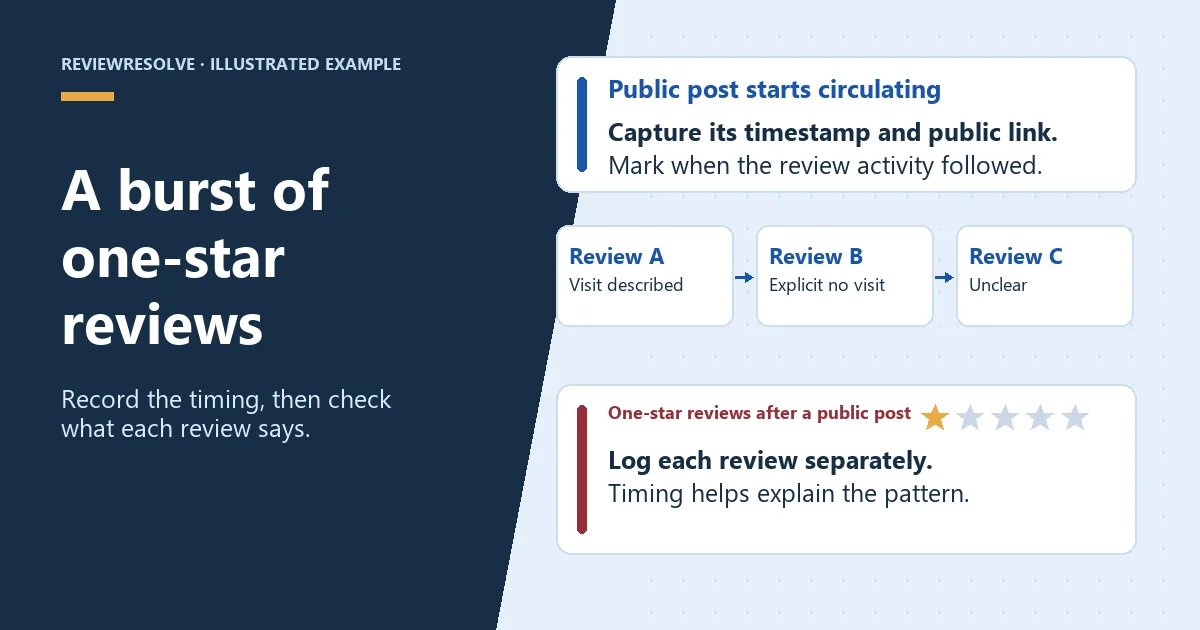
Build one timeline for the practice
Assign one person to record the incident and give branches a way to flag new posts. Save the campaign post’s public link, when the practice first saw it, which branch it names and whether it tells people to leave reviews. For each Google review, record the link, the listing, visible wording and the time staff first saw it. Label a first-seen time as an observation. It may be later than publication.
Record the sequence before drawing conclusions. A news story or a widely shared complaint can prompt past clients to describe real visits. A review saying that its author has never used the practice gives a more specific fact to check. Repeated wording may help explain the pattern when you can connect it to a public prompt. A one-star rating without text supplies less information and cannot by itself establish who posted it or why.
Give each review a next step
| What you can see | What to record | First action |
|---|---|---|
| A review describes a reception call or a visit. | Capture the review link and the aspect of the service described. | Send the feedback to the practice’s usual complaints route. Check any separate policy issue. |
| A reviewer says they have never used the practice and repeats wording from the public prompt. | Record the exact review link and the public post, with the relevant passages. | Check Google’s genuine-experience policy and report the individual review if the evidence supports it. |
| A one-star rating includes no text. | Record the listing and first-seen time. Note the gap in the record. | Review it with any other evidence that directly connects it to the conduct of concern. |
A real complaint still belongs in the practice’s normal process. Apply the RCVS guidance on confidentiality to any public reply. For example, invite the person to contact the practice manager directly and keep appointment, treatment and client details out of the reply. If a review contains a threat or private information, record where it appears and assess that concern under the applicable policy.
Use the timeline to hand over a case
Give the profile manager the affected branch and a short note per review. Where nobody demanded anything in exchange for removing reviews, use the relevant ordinary reporting route. Google has a separate process for negative-review extortion where someone demands money, goods or services.
Check Google’s dedicated route for a demand linked to negative reviews
Worked study of a fictional ninety-minute review log
The example starts when the practice first sees a public post. Each row records the number of one-star reviews first seen in the next thirty minutes. The three wording categories are mutually exclusive in this example. “Visit or call described” records what the author says. “Explicitly says no contact” records the author’s own statement. The remaining reviews are unclear. Add the three counts in each row to reproduce its bar. Add each category down the table to reproduce the category totals. The hours, counts and posts are invented. The exercise measures what someone could record and gives no removal prediction.
- 09:00–09:292
- 09:30–09:597
- 10:00–10:293
| First-seen window | Visit or call described | Explicitly says no contact | Unclear | Total observed |
|---|---|---|---|---|
| 09:00–09:29 | 1 | 0 | 1 | 2 |
| 09:30–09:59 | 2 | 3 | 2 | 7 |
| 10:00–10:29 | 1 | 1 | 1 | 3 |
Sources
- Google Maps content policy
Covers genuine experiences, rating manipulation, harassment, personal information and off-topic posts.
- Google Business Profile · review reporting and appeals
Explains individual reports, report statuses and the one-time appeal where eligible.
- RCVS guidance on social media and client confidentiality
See paragraphs 28.6 and 28.8–28.13 on client confidentiality and practice protocols.
- Google’s guidance for businesses affected by negative-review extortion
Covers demands for money, goods or services in exchange for removing reviews.