
Decide whether to hire help · UK agency account leads and client teams
What should an agency hand over before its client pays for Google review help?
Send a review-specific case note. A monthly reputation report may show a rating drop, but the person taking over needs the exact post, the client’s concern, the last Google status and the action the client wants next. Those four facts let the client decide whether to handle the report themselves or request help.
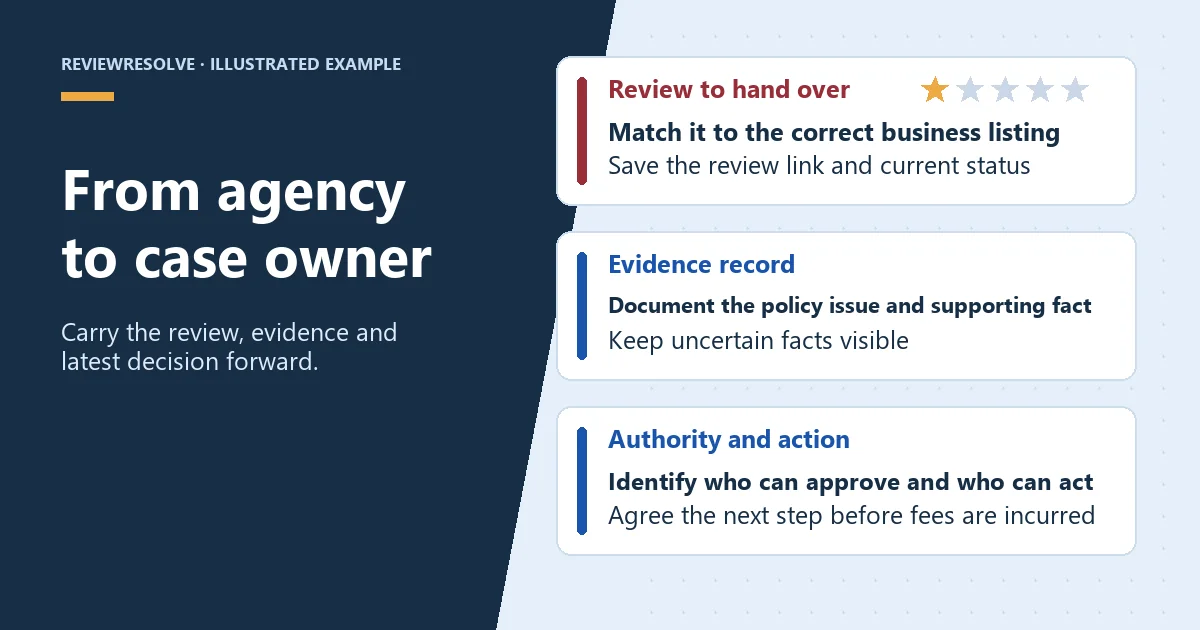
Send one compact record per review
| Field | What to record | What the next person can do |
|---|---|---|
| Public identifiers | The Google review link plus the affected listing or branch. If the review link is missing, record the branch and what remains visible. | Open the right listing without relying on a generic business name. |
| Policy concern and evidence | Point to the disputed passage and one fact that supports the concern. Record relevant uncertainty beside it. | Assess a specific policy question, such as whether the review names another branch. |
| Last confirmed Google status | Record what the authorised person saw in the Reviews Management Tool and when they checked. Mark an unverified status as unknown. | Check for an existing report or an eligible appeal before relying on the old agency ticket. |
| Named action owner | Identify who will check status, report or respond, and what decision the client wants from the handover. | Put the next action with the person who can actually take it. |
A case note can carry public identifiers and a summary while personal evidence stays with the client. If a source contains customer details, describe what it supports and how the authorised person can retrieve it privately. Use the client’s approved access process if someone else genuinely needs to see it.
Confirm authority before anyone acts
The client can request a free assessment while keeping control of the profile. For an on-profile action, identify the person whose own account is authorised to act. Google’s third-party rules require owner consent to claim and manage a profile, and explicit approval to reply on a client’s behalf. Google provides a free route to report and check reviews. A paid scope should say which work the provider would do and which actions remain with the client.
A handover at the end of a retainer
The new team can now distinguish two tasks. The current report has a status to track. The location mismatch still needs a check against public branch details before the client decides whether to commission further case preparation.
Worked study of handover completeness
These three fictional handovers illustrate the four-field checklist. Score each field one when it meets the requirements in the table above and zero otherwise. In the first row a forwarded review link identifies the post and listing. The second models a partial handover with an unknown report status. The third includes all four fields. Sum the four fields to measure how much case information is ready to pass on.
- Link forwarded alone1
- Partial handover3
- Complete handover4
| Fictional handover | Public identifiers | Evidence and concern | Google status checked | Action owner named | Fields present |
|---|---|---|---|---|---|
| Link forwarded alone | 1 | 0 | 0 | 0 | 1 |
| Partial handover | 1 | 1 | 0 | 1 | 3 |
| Complete handover | 1 | 1 | 1 | 1 | 4 |
Sources
- Google Business Profile third-party policies
Explains responsibilities for managing client profiles, owner consent, approvals and fees.
- Google Business Profile owners and managers
Describes invitations and account roles.
- Google Business Profile review reports and appeals
Explains review status, reporting and eligible appeals.