
Check whether a review can be challenged · Private clinic managers using external booking services
A Private Clinic’s Google Review Mentions a Booking Agency. Who Handled the Appointment?
Split the review into the events it describes. A booking agency may send the confirmation, a separate company may take payment and the patient may still experience the clinic’s reception or care. That distinction helps you route the complaint and identify a specific claim worth checking.
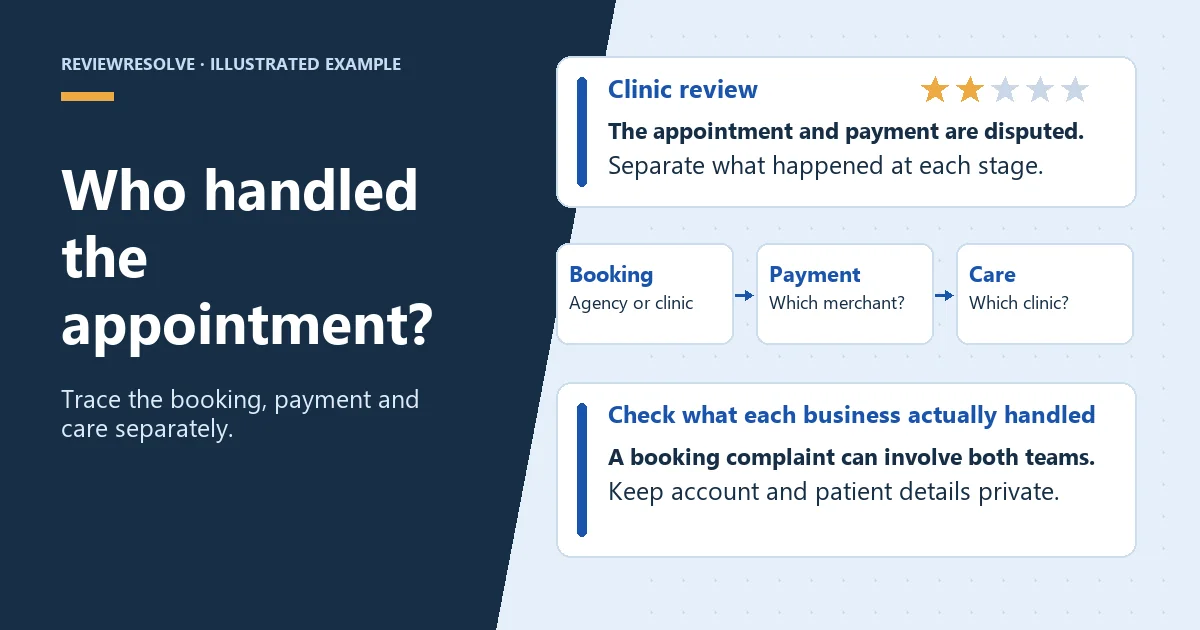
Start with the event the reviewer describes
Follow your public appointment link from the clinic’s Business Profile. Note which business appears on the first booking page, who promises to confirm or reschedule the slot and who is identified as providing care. An agent can manage booking and payment for a genuine clinic visit. Equally, similar clinic names or an outdated link can make a reviewer attribute a service to the wrong provider.
| Stage | First check | Evidence to record privately |
|---|---|---|
| Booking and confirmation | Who offered or confirmed the slot? | Current public booking page, then the sender and date in the approved system. |
| Payment and refund | Who took the payment or promised the refund? | Public payment terms and the payment handler recorded in the relevant system. |
| Arrival and care | Which location and provider delivered the service? | Public clinic address and provider information, then an authorised internal check where needed. |
The public link is a starting point. A trading name on a statement can differ from the clinic brand and a booking link can change after the event. Record which fact the source supports, whether that fact applies to the date in the review, and what still needs confirmation.
Check shared responsibility before assigning a route
Save one internal line per claim. Record the stage, the first team to check, the source and any uncertain hand-off. If you reply publicly, offer a private complaints route without confirming attendance, payment or treatment. The Care Quality Commission’s complaints guidance for England directs patients to the organisation that provided or paid for their care and explains the regulator’s own role. Check the relevant local process for services elsewhere in the UK.
A broken or misdirected booking button is a profile issue. Google explains how to manage local business links, including third-party booking links. A review report concerns the content itself. Compare the exact passage with the public provider details and choose a report only where the evidence reasonably points to a policy issue.
Use a small routing exercise to train the team
The chart below groups six fictional appointment claims by who should check them first. It shows how a clinic can assign a next action without pre-judging who caused the problem. The ‘joint check’ row records a hand-off that needs both teams.
Worked study of six claims about a clinic booking
This example uses six fictional review claims with one initial route each. Assign a claim to the team that controlled the action or holds the relevant record. Use joint check where the first useful check needs both booking and clinic records. Group the rows by route and count them to reproduce the chart. The totals describe only this fictional routing exercise.
- Booking partner2
- Payment handler1
- Clinic2
- Joint check1
| Fictional claim | First check | Route |
|---|---|---|
| The booking confirmation never arrived | See whether the booking platform sent the message | Booking partner |
| The booking reminder listed a different time | Check the reminder and source of the slot shown | Booking partner |
| The promised refund never appeared | Identify who collected and refunded the payment | Payment handler |
| The front desk would not explain the delay | Check what reception was told and communicated | Clinic |
| The consultation started late | Check the clinic appointment record privately | Clinic |
| The booking platform confirmed a revised time that reception could not see | Compare the confirmation event with the clinic’s receipt of the change | Joint check |
Sources
- Google Maps rules on genuine experiences and location relevance
- Google’s local business and booking link guidance
- Google’s review reporting and appeals instructions
- Care Quality Commission guidance on complaints about a service or provider
Applies to this regulator’s remit in England.
- ICO guidance on data minimisation