
Gather evidence · UK businesses with repeated complaints
Two Google accounts posted the same complaint. Which reviews should you report?
Save both review links and compare the complete posts before choosing what to report. Two reviews may describe the same real event. An unusual passage copied across two accounts gives you a specific pattern to document, especially when other available facts support a policy concern.
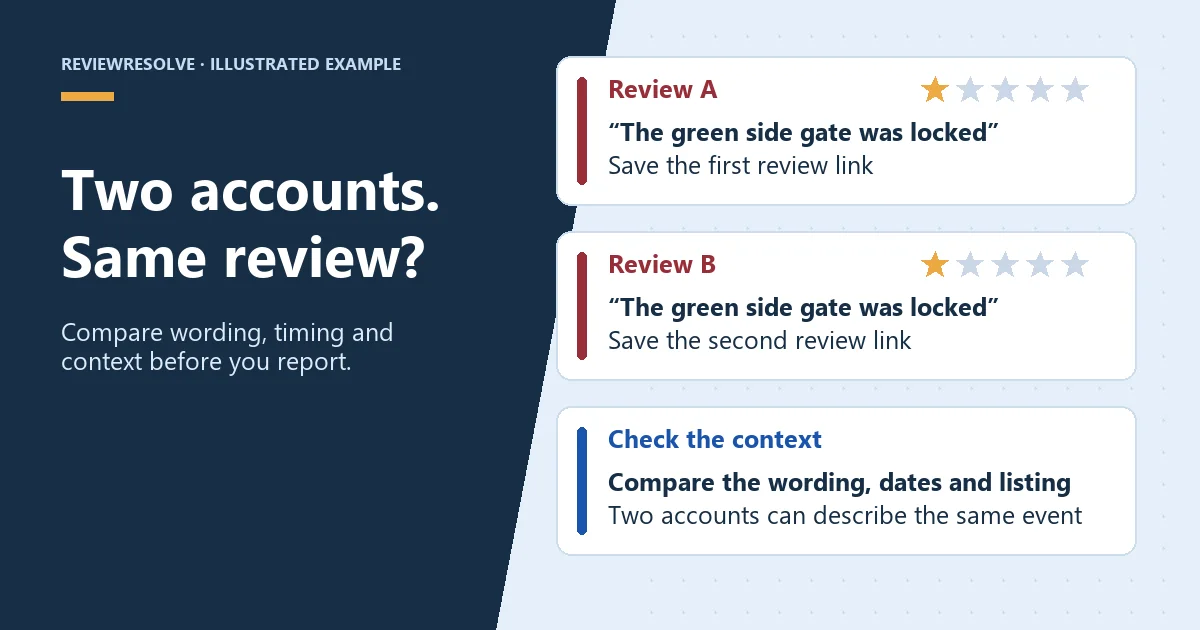
Compare the two posts on the same record
Open the listing for the correct branch, then save the direct review links where available. Record the wording, date as displayed, when you captured it and any existing report status for each item. If you can see only a relative time such as ‘two weeks ago’, record that wording and the capture date. Avoid filling in a precise posting time you cannot verify.
| What you see | What to check | How to describe it |
|---|---|---|
| Identical or near-identical phrases | Look at the complete reviews and whether other details match. | Quote the short repeated passage and attach both public references. |
| Same service incident | Check whether two people could have experienced it separately or attended together. | Record what each claims to have seen. A shared complaint can be genuine. |
| Two profile names | Record how each item appears on Maps. | Describe two accounts without asserting they are controlled by one person. |
| Different branch or date claim | Check against public branch details and any reliable timeline. | Name the specific mismatch and state the limits of your evidence. |
When shared wording is worth reporting
Google’s Maps policy lists repeated posting of the same content under repetitive content. Its fake engagement policy also addresses content posted from multiple accounts by or at the request of one person. These are different facts. You can document repeated content from two public review links without claiming to know who posted it.
The chart below gives a quick way to compare wording when there are several pairs. A common phrase such as ‘never again’ should carry little weight. Even identical text cannot establish common ownership, an incentive or a removal outcome. Keep the raw text only as long as necessary for your case, and leave private customer details out of initial enquiries.
Open the right report for each review
- For identical wording with a credible repetition concern, keep both links and a short comparison so Google can identify each post. Choose the most accurate available reason for each one.
- For different accounts of a real incident, address the underlying service issue when you cannot identify a separate policy concern.
- If you already reported one review, check its status before taking further action. Use an eligible appeal for a declined report only if there is evidence worth clarifying. A report on one post does not establish the status of the other.
Worked study of wording overlap in four fictional pairs
The examples use simple word-set overlap. Lower-case each line, split on anything outside A–Z, and count each distinct word once. Divide the number of shared words by the number of distinct words across both reviews, then round the percentage to the nearest whole number. Word order and meaning are outside this calculation. The comparison helps organise evidence for reading. It measures neither policy violations nor removal likelihood.
- A · Identical wording100
- B · Reused uncommon phrase89
- C · Common phrase only20
- D · Separate details0
| Pair | Review A | Review B | Shared words | All distinct words | Overlap percent | Check next |
|---|---|---|---|---|---|---|
| A · Identical wording | the green side gate was locked after my tuesday fitting | the green side gate was locked after my tuesday fitting | 10 | 10 | 100 | Check dates, listing and independent context. |
| B · Reused uncommon phrase | numbered blue ticket left in the side gate | they left the numbered blue ticket in the side gate | 8 | 9 | 89 | Save the unusual phrase and check the rest of each account. |
| C · Common phrase only | never again long wait for keys | never again broken zip on coat | 2 | 10 | 20 | Treat the shared phrase as weak evidence. |
| D · Separate details | my repaired shoes were ready late | the till receipt listed two bags | 0 | 12 | 0 | Record as separate allegations. |
Sources
- Google Maps prohibited and restricted content
Defines repetitive content and fake engagement, including multiple-account posting.
- Google’s reporting, status and review appeals guidance
Describes how to report a specific review and check for an eligible appeal.