
Check whether a review can be challenged · UK retailers, showroom teams and service businesses
A customer’s Google review contains an affiliate link. When is it promotional?
Look at what the reviewer is asking readers to do. Naming the model they bought can help describe a genuine visit. Asking readers to buy from another site with a referral code raises a different concern. Google’s advertising and solicitation policy also lists links to other websites in user reviews, so you can describe the link without claiming the reviewer earned a commission.
In this update Clarified how Google’s review rules apply to incentivised content and why UK disclosure is a separate question.
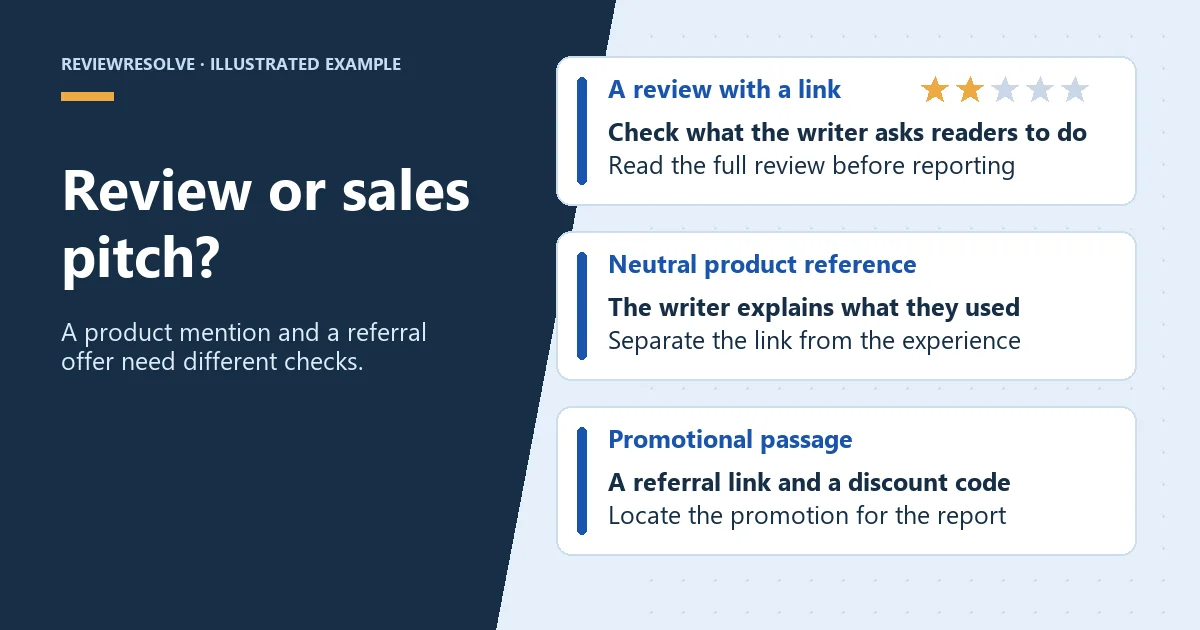
Read the line around the link
Check whether the link earns a commission, redirects to a seller or represents a deal offered in exchange for posting. Google’s review policy prohibits offers of payment, discounts or gifts tied to publishing or changing a review. UK consumer reviews guidance also addresses concealed incentives. In a Google report, explain what the review actually asks a reader to do and what you can verify about any reward.
Record the part of the review that points readers elsewhere and any nearby call to buy, book or use a code. A page address with a long string of parameters can be tracking for many reasons. If all you can see is the link, tell Google it is a link. If there is also a discount offer or an instruction to buy from the reviewer, record those visible facts.
| What the review contains | What the facts show | A sensible next step |
|---|---|---|
| “I tried the Oak desk in the showroom.” | A named product and a claimed experience at the shop. | Check the claim as ordinary customer feedback if there is no separate policy concern. |
| “Here is the manufacturer page for the model I bought.” | An external link with an apparent reference purpose. The review itself may still describe a genuine purchase. | If reporting, use the external link rule accurately. Establish a paid relationship separately, for example from a commission disclosure. |
| “Buy from my shop with this link and use my code.” | The post contains a purchase instruction, a destination and a promotional code. | Record that passage and the destination as shown. Assess the promotional content and the external link. |
| “I earn a commission if you purchase here.” | The author discloses a financial relationship with the linked purchase. | Record the disclosure as part of the facts. Google still applies its own rules to the review. |
The UK Advertising Standards Authority describes affiliate marketing as marketing in which an affiliate can be rewarded for the interest or sales their links generate. This can help you interpret an explicit commission disclosure. Google’s review process applies its own content policy regardless of how an advertisement is labelled.
Preserve the evidence on the listing
- Save the review’s own link and the destination advertised inside it. Add the Google Business Profile and the line that uses the referral link or code.
- If you can see where the link points, record the displayed domain. Separate what the text shows from assumptions about who controls the site or gets paid.
- File a report through Google for the specific review if the evidence supports it. Keep the report status and any later edit with your case notes.
A genuine product comment with a sales instruction
If the author later edits the review to remove the link and sales pitch, check what remains on the listing before deciding what action is still useful. A product name and a description of the test ride need a different assessment from the earlier version.
Sources
- Competition and Markets Authority — fake and incentivised reviews guidance
Explains the consumer review rules for businesses and review publishers in the UK.
- Google Maps content policy
See advertising and solicitation and the rules for links in user reviews.
- Google review reporting and appeal guidance
Explains reporting, status checks and eligible appeals.
- ASA and CAP guidance on online affiliate marketing
Explains affiliate marketing and recognition of associated advertising in the UK.